On checking, I've had it for two years now. 🙂 Mine has a motor. I would not say I'm an expert and I don't have any experience with other roasters so I cannot compare. I did have some "chuck out" roasts when learning - actually, I sent them to work with my husband because the people there had no idea of what good coffee actually was and so they all loved them. I aim for first crack at ten minutes and for second crack to start at about fifteen. That is what I read on someone's discussion about using it and have been following that ever since. I had to switch burners around a bit until I worked out a method that worked for me. Some people use those small portable ones with the butane bottles. I use the stove. At first I used a midsize burner and an aluminium foil baffle to concentrate the heat, which I needed to have it hot enough. These days, I get it to first crack on the wok burner to get the timing right and then switch it to a smaller one when first crack is established to coast through a bit more, as I read that first crack is exothermic and so you don't need to use as much heat during it, and also not after it, you can let the beans go into second crack at a lower temperature. I do need to keep some heat on into second crack but it's much less. Certainly to get those target times you need to get the heat down once first crack is happening but it's best to wait until it's rolling so it doesn't stall. Drop the heat too soon and it will tend to stall and that's not too great. You can turn the heat up again and it goes but it's not as good. It *is* pretty responsive to heat input changes. What works for me is to have it fairly hot until smoke starts coming, then back it off a bit, then let it get into rolling first crack, then take it to a slower heat so it doesn't gallop into second crack too soon. Depending on the bean and the planned extraction method I usually finish it a bit before second crack, at the first snaps of second crack, or when it's got a little more into second crack. With the time targets I mentioned above. I do give it a visual check as it goes, generally in the period after first crack, but when learning I was doing it more often. I rely on ear a lot more now, but as it's getting close, I'll tip a few beans into the bowl I'm putting them into, and decide whether to stop then or to go a bit longer. Even if I do that a few times that's OK because it's just a mix of flavour profiles from lighter to darker and I don't mind that. Obviously I'm doing that after a check into the drum shows that they are pretty close to being ready. You need a decent directed light to do that. Different beans will sound different. Some will crack louder or quieter, they may go all around the same time or others will crack over a longer time period. First crack is louder and some have a very subtle second crack. It's very seat-of-the-pants and I'm probably not doing it to the absolute optimum but I've been enjoying what I've been drinking and others enjoy it too so something is going right. You won't be expecting as even a roast as you would get in say a convection roaster. If I post photos I get comments about unevenness and also about divots in the beans but I don't worry too much about that these days, it's kind of a function of the fact that some beans will end up contacting the copper more than others, even with shaking. Some varieties will tend to roast more evenly and some less so. The unwashed Africans simply will not roast evenly for me. But, generally my beans tend to be more even than the photos you have been showing. So, something to work on. I don't shake all that often and sometimes I forget for a few minutes, like if I'm doing something else at the time. When I do, I use a sort of figure eight motion, to try to get it all mixed up. I try to do it at least every couple of minutes. Probably that's not optimum either but it's working OK. I've read every minute is good but that means I can't easily go and load the dishwasher or whatever while roasting. Whether to roast different beans together or separately, for me, depends on the bean and what I want out of it. If they are similar in size and hardness I'll do it more together if I'm blending. Lately though I tend to roast different beans separately. But most recently I'm just grabbing roasting time windows when I can and doing single roasts of SO beans like Yirgacheffe and PNG Kimel, instead of roasting greater numbers of types of beans separately. Like I said, I'm not an expert and also I can get a bit distracted, but it's good enough for me and for the people that I've given coffee to. 🙂 The photo below was from October last year. I was experimenting with roasting a bit lighter than I'd mostly done in the past. I got a bit distracted on one of them (I often multi-task when roasting and check in while doing other things, and/or keep an ear on it) and it got a bit darker than intended but it tasted OK. In no particular order, there are Brazilian, Honduran, Ethiopian and Sumatran beans in the photo. 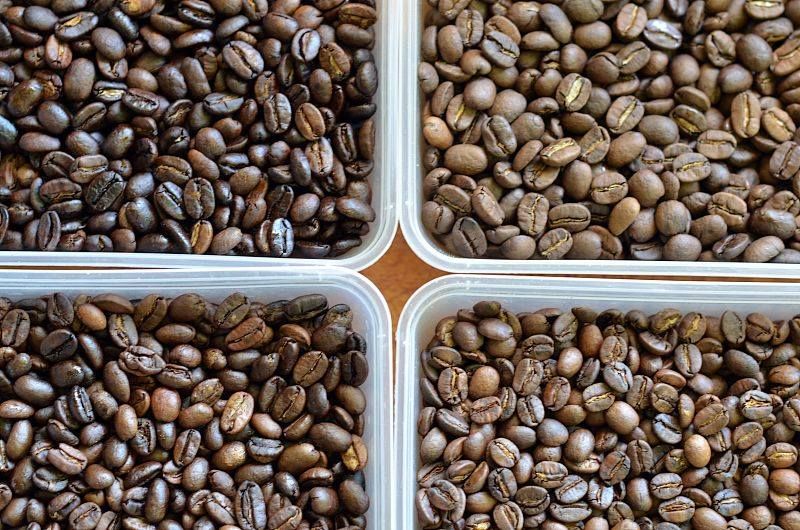 I hope my post helps. I'll answer any questions you have of me, with the disclaimer that I'm only someone who enjoys a bit of home coffee roasting and drinking.