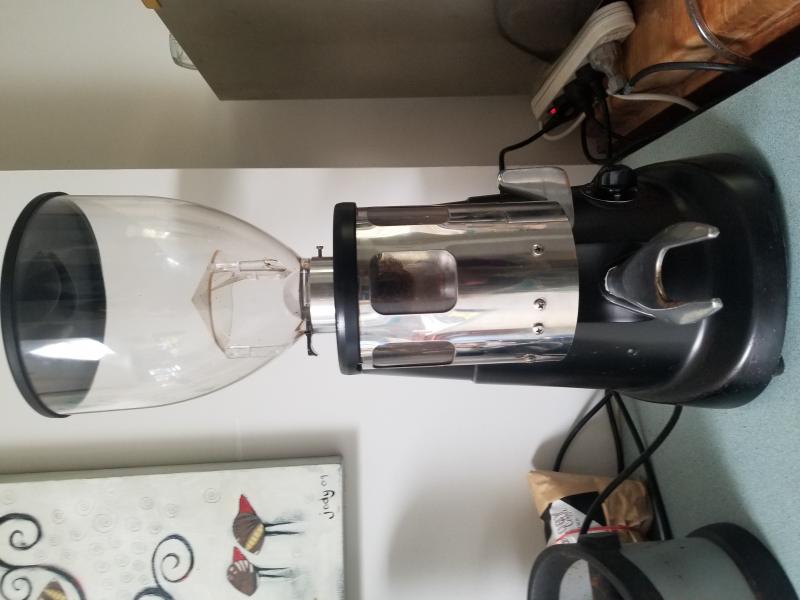
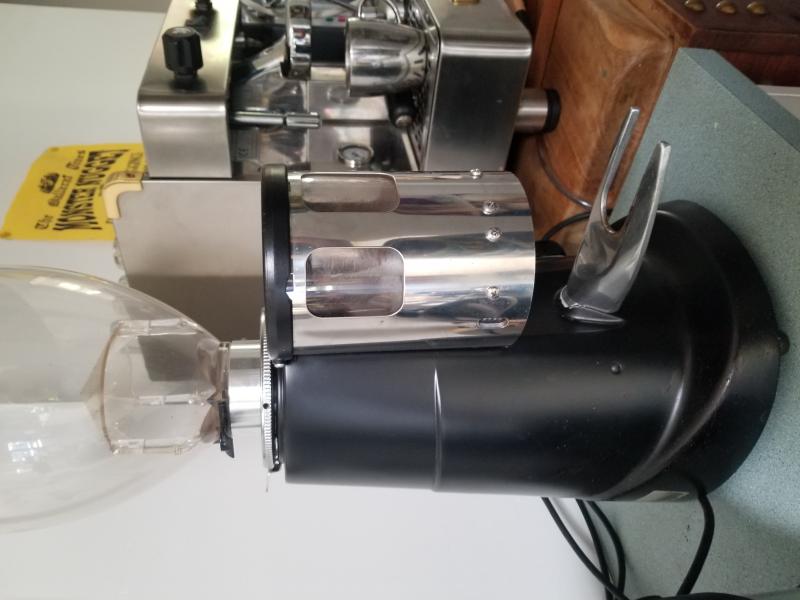
I’m copy and pasting this from Home Barista. It explains why conicals are so consistent and easy to adjust relative to flat burr grinders... is a technical explanation from the Titan grinder thread... Yer all wrong. It's simple geometry. The threading on the grind adjustment collar between a Robur and a Super Jolly have a very similar pitch. In other words, one 360-degree rotation of the grind adjustment collar results in the same vertical movement of the upper burr set. However, flat burrs sit completely parallel to each other. They're like a sandwich. When you move the upper burr set, say 0.10 mm vertically, the gap/distance between the burrs at the final cutting edges moves 0.10 mm apart from one another. In a conical burr grinder, the grinder burrs are configured significantly differently, with the cutting edges converging at the "grind gap" at diagonal angles. 0.10 mm of upper burr movement does NOT widen the gap between the final cutting edges by 0.10 mm. It's something fairly smaller. Anyone who's seen conical burrs (esp. Kony or Robur burrs) and flat (SJ) burrs can, I believe, visualize what I'm talking about. It's sort of hard to explain. (illustrations would help... but I'm too lazy) That's why conicals "need less adjustment" than flat burr grinders. At espresso-grind fineness, one radial unit of collar adjustment/movement on a SJ equals about (just a guesstimate based on extensive experience) 3 to 5 units of movement on a Robur, when adjusting for flow rate. Sent from my iPad using Tapatalk